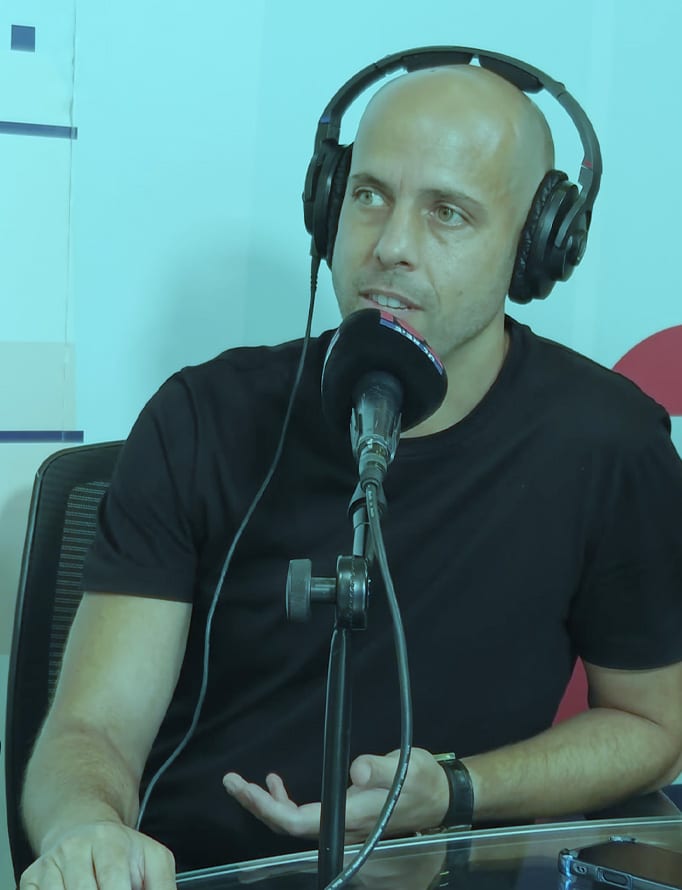
Nir Shamul, CEO of Shani and the Urban Development and Renewal Company, appeared on the radio program “Building Far” for a conversation with Merav Miller and Aviv Cohen. In the interview, Shamul talks about the long journey he has taken from telemarketing to leading dozens of real estate and urban renewal projects, about smart investments abroad, about philanthropy as a way of life—and about the sense of mission that has accompanied him since childhood.
In the latest episode of the radio show “Building Far,” hosted by Merav Miller and Aviv Cohen, Nir Shamul, CEO of Shani and the Company for Urban Development and Renewal, was a guest to discuss his background, his business ventures in Israel and Greece, his philanthropic activities, and his views on the real estate market and society in Israel.
""I started out in telemarketing": The long road from Gindi to independence
Shmul has been working in real estate since 2001, including a decade at Gindi, and currently serves as CEO in two roles: one at the Urban Development and Renewal Company, which focuses on enhancing land value for apartment owners through large-scale urban renewal projects throughout Israel, and the other at Shaniir, which markets real estate projects in Israel and abroad.
Looking back on his early career, Shamul recalls that he started out in telemarketing, the most junior position. He remembers his first project, Gindi Park in Holon. Over the years, he advanced through various roles at Gindi, including sales representative, sales manager, national sales manager, marketing director, and vice president of business development. He describes his years there as “amazing” and expresses deep appreciation for the Gindi family, both professionally and personally.
Urban Renewal as the Fulfillment of a Personal and Collective Dream
Shmul believes that starting from the bottom provides the best foundation. He feels that having held nearly every position in the real estate industry himself enables him to understand and lead his teams effectively. He emphasizes the importance of hard work for personal growth and notes that he has always faced challenges in his life. His entry into urban renewal was also driven by personal motivation, having grown up in a small apartment in Ramat Gan that was slated for urban renewal. His family finally moved into a new home after a process that spanned many years. During his time at Gindi, he tried to promote urban renewal projects, but the company preferred faster-paced ventures. A conversation with architect Gil Shenhav, who was involved in many of Gindi’s projects and also worked in urban renewal, sparked his interest in the field. After leaving Gindi at the end of 2011 and completing his master’s degree at Wharton, Shamul contacted Shenhav, which led to the acquisition of shares in the urban development and renewal company. Since 2011, he has served as CEO of this company, and in 2013 he also became CEO of Shani. His urban renewal company focuses on increasing land value for apartment owners in demolition-and-reconstruction projects and manages 30 projects simultaneously in central Israel, Jerusalem, the north, and the south. He sees his work in urban renewal as the fulfillment of his childhood dream of a new home—now for many others.
Gindi's Departure – Retiring at the Top to Pursue Ventures Close to His Heart
When asked about his reasons for leaving a successful position at Gindi, Shamul explains that he felt he had hit a “glass ceiling” there. He believes in leaving at the peak of his career and felt that staying longer might have ended less favorably, despite the significant professional and financial growth he had experienced. He had a gut feeling that it was the right time to move on, even without another job on the horizon. He recalls that his first independent marketing project was a 1,000-square-meter commercial center in Tzur Yitzhak, in stark contrast to the large-scale projects he managed at Gindi. In that project, he was the salesman, his sister Liron was his telemarketer, and he even did the door-to-door marketing himself. This passion for building something of his own from scratch was a central driving force, even more so than financial gain. He values the sense of independence and the ability to do good for people, which motivates him greatly.
When Business and Philanthropy Meet
Regarding his time management, including his involvement in charitable activities, Shmul notes that he doesn’t feel he has ever worked a day in his life because he loves what he does. He maintains a positive outlook and avoids comparing himself to others, cultivating an attitude of generosity and giving. His desire to help others stems from his upbringing and his experiences in the military. During his service as a screening officer at the Induction Center, he was exposed to significant disparities in Israeli society and recalls instances where soldiers did not even have enough money to travel home. He decided that if he ever had the means, he would try to create more equal opportunities. Between 2010 and 2020, his charitable foundation focused on education, running a holistic program with various municipalities while providing financial support and mentorship to hundreds of children from underprivileged families, some of whom even went on to become officers. Real estate entrepreneurs also served as mentors, exposing these children to business opportunities. When the COVID-19 pandemic began in March 2020, Tel Aviv University, a key partner in the initiative, suspended its activities. Instead of fighting this decision, Shmul saw it as an opportunity to make a change. In April 2020, a new charity fund was launched, focused on providing basic needs and support to anyone in need, distributing food baskets, assisting with job searches, and providing essential items, primarily through volunteers. He believes it is everyone’s responsibility to create equal opportunities.
Investing in Greece – An Economic Opportunity with Responsibility
Regarding investing in Greece and Israeli investments in Greece, Shmul notes Aviv Cohen’s expertise. As someone who has been involved in marketing and real estate for many years, he considers Aviv Cohen’s company to be the best currently operating in Athens, and highlights his understanding, knowledge, and professional analysis in Greek real estate. Shamul notes that due to the high cost of living in Israel, many Israelis are drawn to the affordability of properties in Greece, which range in price from 500,000 to 800,000 shekels. The ability to demonstrate a track record and experience is critical to overcoming Israelis’ fear of exploitation, which has indeed occurred in some overseas real estate projects, unfortunately. Palmo, he says, provides that assurance. He acknowledges the significant outflow of Israeli capital for overseas investments, a trend that concerns him as an Israeli. He recalls that in the past, international real estate projects required multiple trips, whereas today 80–90% of transactions are completed without the need for flights, often based solely on presentations. Given the high prices in Israel, the more affordable options in Greece represent a practical alternative. Among other things, Shamul points out the absurdity that it is now easier for him to buy and sell an apartment abroad than in Israel.
Reserve Duty and Solidarity: Assistance for Thousands of Evacuated Families
Shmul shares his recent experience during the October events and reveals that he is still serving in the reserves, having served for over 450 days. That Saturday morning, he received a call from former Knesset member Nira Shpak, a resident of Kfar Aza, who urged him to open his WhatsApp group, “Mala’chei Shani.” Although he had never opened the group on a Saturday before, he felt a sense of urgency. Shafak anticipated that the government might not respond quickly enough to assist residents of the Gaza border area who would need to evacuate. She asked him to reach out to people in central Israel to host the displaced residents. Shmul, who initially hesitated due to his observance of Shabbat, finally opened the group. Within 44 minutes, 1,024 families had joined the group, and within a single day, five groups had facilitated approximately 5,000 accommodations for people from the conflict zones. In closing, he highlights the incredible solidarity of ordinary people who opened their homes to the evacuees.