


Short answer:
Israelis are investing in real estate in Greece due to relatively low entry prices, its proximity to Israel, a thriving tourism industry, economic recovery, tax benefits, and the opportunity to obtain a Golden Visa. For many, Greece offers an accessible European market with potential for returns.
In recent years, there has been a growing trend of Israelis buying apartments and properties in Greece— in major cities such as Athens and Thessaloniki or on exotic islands—each for their own reasons: to purchase an apartment as an investment, for residential use, as a family vacation home, or as a property “to have on hand in case of need, should any misfortune befall us,” in keeping with Jewish tradition.
What are the reasons behind the growing trend of Israelis investing in real estate in Greece? What is particularly appealing about the land of bouzouki and tavernas, and how is the Greek government encouraging this trend? The answer involves several factors, but we’re here to break it down for you.
A little sip of ouzo—and here we go!
Close to the eye, close to the heart
Buying a property is a complex process fraught with worries and concerns, and when it comes to buying an apartment overseas, those concerns intensify even further. In this regard, Greece offers a major advantage for Israelis, who can acquire an income-generating property with a handsome return just a short flight away—or a boat trip, if you prefer. The ability to see the property in person, meet with potential tenants, and generally stay involved in what’s happening there is what sets investing in an apartment in Berlin or Portugal apart from buying a property in Greece. And if you can combine the trip to inspect the property with a quick vacation and a chance to clear your head along the way, then why not?
On another note, even for Israelis who purchase an apartment for vacation purposes—an exotic location that will serve as a refuge from their hectic daily lives—geographical proximity plays a decisive role, as it allows them to decide to go on vacation spontaneously and at the “last minute,” without having to deal with long and tedious flights. Consequently, you’ll see quite a few Israelis choosing to buy vacation homes in Greece—a topic we’ll discuss in more detail later on.
The Economic Crisis: A Once-in-a-Lifetime Investment Opportunity
One of the most important skills in real estate investing is identifying opportunities that come your way and seizing them. In other words: strike while the iron is hot. There seems to be no better example to illustrate this than the economic crisis Greece experienced 14 years ago.
The 2008 economic crisis hit Greece hard and brought it to the brink of bankruptcy. The Greeks themselves found themselves in an extremely difficult socioeconomic situation, with some lacking pensions or any other available capital for investment. In the wake of the crisis, banks shut off the “mortgage tap,” and anyone wishing to purchase an apartment was required to provide 100% equity (!) with absolutely no leverage. Although there has been some easing of mortgage policies in the past year, many Greeks are still “sitting on the fence” and refraining from buying an apartment—partly because a whole generation in Greece grew up without ever taking out a mortgage and the scars of the crisis still echo in their ears, and partly due to rising interest rates worldwide, which have brought investment to a halt.
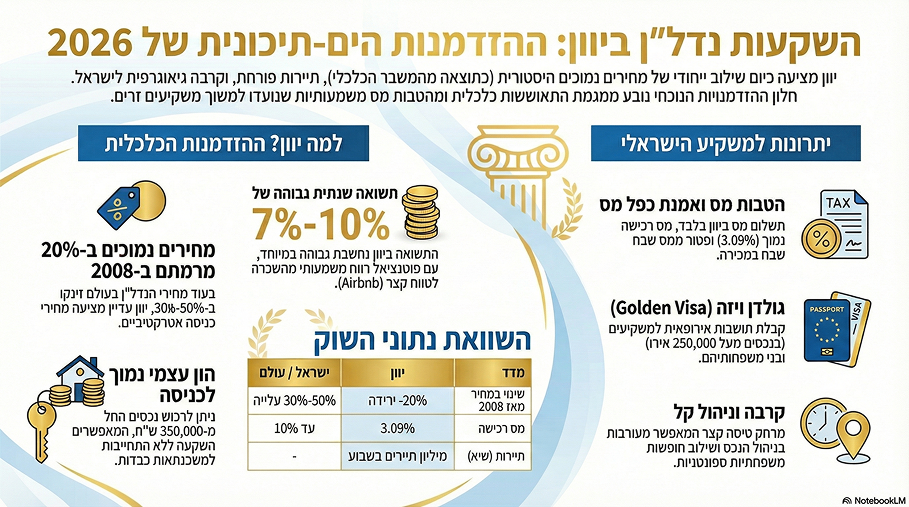
The economic crisis and its repercussions have caused real estate prices in Greece to plummet by tens of percent, while at the same time the local population lacks the available capital to invest, certainly not in high-quality real estate in cities such as Athens and Thessaloniki. Just to illustrate, real estate prices in Greece are currently 20 percent lower than they were in 2008, while real estate prices in the rest of the world have risen by 30–50 percent since 2008!
And what’s the result? A once-in-a-lifetime opportunity to purchase an apartment in Greece at relatively low prices and in attractive locations, with the real icing on the cake being the expectation of future price increases and a handsome return. Why are prices expected to rise? First, because in 2015 Greece signed an economic recovery plan with the Eurozone that is progressing well and bearing fruit; and second, because the financing component (mortgages) is directly linked to rising prices, and it is expected that once the “dam breaks” and Greeks begin taking out mortgages, real estate prices will rise accordingly.
In summary, since 2016 there has been a gradual but steady improvement in the Greek economy, and in the coming years there is a chance that it will recover almost completely—making the window of opportunity to purchase Greek real estate narrow and rare, and the investment particularly attractive, as future profits are still just around the corner.
Tax Benefits
A country can attract or deter real estate investors primarily through its tax policies. In Greece, at this point in time, there is a strong interest in encouraging foreign investment—which has led to a lenient and buyer-friendly tax policy that is enticing quite a few Israelis to look toward apartments in the island nation. How does this policy manifest itself?
Tourism, ladies and gentlemen, tourism
It is impossible to discuss investing in Greek real estate without mentioning the country’s status as a bustling international tourist destination. This advantage ensures that in certain areas, there will always be demand from tourists for vacation properties, rental apartments, and Airbnb listings. In fact, in recent years, demand for Airbnb rentals has been growing as an alternative to high hotel prices. Another advantage is that, thanks to the thriving tourism industry, islands and resort towns are constantly undergoing development, leading to rising property values. Buying a home in Greece can be a particularly lucrative investment in these areas. Take, for example, two particularly famous islands—Santorini and Mykonos. Until about 30 years ago, both were considered “ordinary islands,” and before the 1970s, they weren’t even on the tourist map. Today, however, they have become symbols of luxury and social status, with celebrities and the wealthy flocking to them from around the world for hedonistic, colorful, and highly “Instagrammable” vacations. The development of these islands has led to an extreme rise in real estate prices, and how should we put it? Those who were the first to recognize this opportunity struck it rich—big time.
A glance at data from the Greek Ministry of Tourism illustrates just how much of a “tourism powerhouse” the country is; in 2022, an average of about one million tourists per week was reported. Yes, you heard that right—one million in a single week. According to data from September 2022, annual revenue from tourism in Greece reached a record high of 20 billion euros (!), and in 2021, the country was even awarded the title of “Europe’s Leading Destination.” Two years ago, Greece’s Minister of Tourism, Vasilis Kikilias, described the tourism industry as “the engine driving the Greek economy, accounting for about 25 percent of it.”
These facts highlight the enormous potentialof real estate investments in Greece, especially in tourist areas. In summary, where there is water, there is life, and where there is tourism, there are income-producing properties. This rule of thumb makes investing in Greek real estate—especially in tourist areas and high-demand locations—particularly lucrative.
Vacation Real Estate
Let's hang out at the taverna, let the muses roar a little…
Hand on heart, who among you would turn down an exotic beachfront vacation apartment, with the sun caressing your skin and the melodies of a bouzouki in the background—all just a short flight away? Well, we’re sorry to break it to you, but you haven’t exactly reinvented the wheel. Quite a few Israelis have chosen to purchase vacation apartments in Greece to treat themselves to an escape and some relaxation from time to time from the intense daily routine here in the Holy Land. Of course, you can rent out that same apartment to tourists for the rest of the year, and reserve your annual vacation dates in advance so that the apartment will be available for you whenever you want.
An exceptionally profitable return
The return on real estate investments in Greece is considered high, ranging from 7 to 10 percent per year. As mentioned earlier, the level of return is directly linked to Greece’s recovery from the crisis; therefore, you should seize this opportunity and purchase a property now to reap the benefits in the near future.
Low Equity
Young people with about 350,000 shekels can buy an apartment in Israel, but they’ll take on a heavy, long-term mortgage. Retirees with a similar amount are unlikely to take on mortgage debt, so investment opportunities in Israeli real estate with that kind of sum are extremely limited. In Greece, however, both of these groups—and indeed anyone with capital available for investment on this scale—can purchase a nice apartment without taking on significant financial obligations. It should be noted that sometimes a certain amount must be set aside for renovations, as well as for maintenance and payments to professionals—but in the long run, the investment pays off.
Palm recently launched the option to take out a mortgage to purchase property in Greece through an Israeli company, with quick preliminary approval and favorable terms, which makes the decision easier and allows Israeli investors to bring in a lower amount of equity.
The Eurozone's "financial backing"
One of the most daunting aspects of investing in overseas real estate is the fear that one day the country might find itself at war or facing bankruptcy, and the investment would be “lost.” True, the likelihood seems relatively slim, but if you ask Israelis who invested in apartments in Kyiv, Ukraine—a destination once considered a real estate hotspot—they will undoubtedly tell you otherwise, given the outbreak of the Russia-Ukraine war. Even without going as far as a war scenario, any country facing economic difficulties and instability is “prone to disaster” and may change its tax policies—including real estate levies—in an instant. In such a case, instead of focusing on profitability and returns, the property owner suddenly finds themselves wondering “how to get rid of it with minimal loss.” Not easy at all.
In this sense, Greece can offer investors peace of mind thanks to the economic “backing” provided by the Eurozone. It was that very “backing” that saved Greece from massive bankruptcy exactly 14 years ago. In fact, precisely because of that economic recovery plan, Greece is more committed to the Eurozone than ever, and it does not appear that it will leave anytime soon. Conversely, the Eurozone is not likely to let Greece go so quickly, given its enormous tourism potential.
In conclusion, Greece is a stable and significant member of the European Union and the Eurozone, which provides it not only with economic support but also with relative political stability. All of this contributes to peace of mind for real estate investors, who are flocking to the country in search of income-generating properties overseas.
Golden Visa
The “Golden Visa” program, which is part of the Greek government’s policy to encourage foreign investment, allows anyone who purchases a property worth 250,000 euros or more to receive residency for five years. Greece’s Golden Visa is considered to have the lowest entry threshold compared to other European countries, and it applies not only to the investor but also to their family members. Furthermore, it can be renewed indefinitely, as long as proof of ownership of the property is provided. This means that for a relatively low investment, a family can move to live in Greece or in other countries that are part of the Schengen Agreement. Due to the high demand for the Golden Visa, the Greek government recently decided to raise the minimum investment threshold in some regions to 500,000 euros. Therefore, it is unclear how much longer this benefit will last, or under what conditions it will continue. It should be noted that the Golden Visa does not apply to Israelis who hold European citizenship.
In conclusion, we began with a song by Haim Moshe, and we’ll end with it as well:
"Let the sun shine"
About Houses in White
Let the heart just be happy
"Just like back then in Greece"
Questions and Answers
By what percentage are real estate prices in Greece lower today compared to 2008?
According to the latest data, real estate prices in Greece are currently about 15% lower than they were in 2008. This follows a period at the height of the economic crisis when prices fell even more sharply. Real estate prices in Greece continued to decline through 2017, reaching a low point where they were 40% to 50% below their 2008 peak.
Since 2017, the market has shown signs of recovery and stabilization, with price increases in recent years.
It is important to note that this trend places Greece in a unique position compared to the rest of the world, as in many other countries real estate prices have risen by 30% to 50% since 2008.
On average, how many tourists visit Greece each week?
Based on the most recent data, the average number of tourists visiting Greece each week is about one million. This figure reflects the impressive recovery of the Greek tourism industry following the COVID-19 crisis.
In 2024, Greece welcomed approximately 35 million tourists.
What percentage of the Greek economy does the tourism sector account for?
The Greek tourism industry contributed 28.5 billion euros to the country’s economy in 2023, accounting for 13% of GDP. By comparison, the average for OECD countries is 4.4% of GDP derived from tourism.
What is the range of annual returns on real estate in Greece?
The annual return on real estate in Greece ranges from 4% to 12%, depending on the type of property and the rental arrangement.
For long-term real estate investments, the gross annual return ranges from 5% to 6%. For standard rentals, the yield can reach 5%–8%, while daily rentals to tourists may yield up to 12% per year.
It is important to note that the yield varies depending on the property’s location, size, quality, and rental demand in the area.
What is the minimum amount of equity required to purchase an apartment in Greece?
There are small properties, or those in developing areas, where you can find properties priced at around 100,000 euros; in some cases, it is possible to purchase an apartment for less than 60,000 euros, especially if you are looking to buy older properties or properties in need of renovation.
What is the purchase tax rate in Greece?
The purchase tax rate in Greece is 3.09% of the property’s value. It should be noted that the property’s value is determined based on the tax authorities’ assessments and not necessarily on the price agreed upon in the transaction.
In addition, it should be taken into account that the Greek authorities may assess the property’s value based on land registry records, and the purchase tax will then be calculated accordingly.