


Brief summary:
EU policies affect the real estate market in Greece through building regulations, infrastructure financing, environmental requirements, and economic policies. For investors, EU regulations can influence costs, property quality, and future demand.
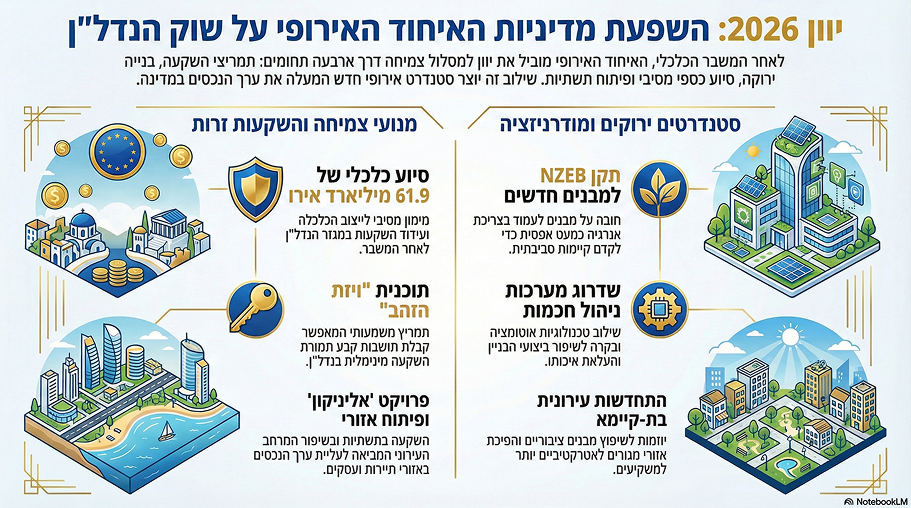
Following the economic crisis that struck Greece in 2008, European Union policies are reshaping the Greek real estate market through four key areas: incentives for foreign investment; green building regulations mandating energy efficiency and sustainable construction; significant financial assistance, including funds amounting to billions of euros; and regional development programs that upgrade infrastructure and enhance investment attractiveness. The combination of these factors creates a competitive and progressive environment that sets Greece on a path to future growth in line with European standards
The real estate market in Greece is heavily influenced by European Union policies and regulations, which play a significant role in the country’s economic recovery and growth. Following the economic crisis that struck Greece between 2008 and 2017, the European Union implemented a number of fiscal and political measures to help the country recover and revitalize its economy, including the real estate market.
The European Union’s influence on the Greek real estate market is evident in a variety of areas, ranging from building regulations to economic policy and regional development plans. Understanding these influences is essential for analyzing current trends and future developments in the sector.
Incentives for Investors
The European Union has provided Greece with significant financial assistance, which has been channeled into infrastructure development programs and tax incentives for foreign investors. For example, the "Golden Visa" program allows investors to obtain permanent residency in Greece in exchange for a minimum investment in the purchase of a home in Greece, which serves as a significant incentive for foreign investors.
Building Regulations
The European Union promotes projects that meet the Union’s sustainability and energy requirements, leading to stricter standards in the construction sector. Developers in the Greek real estate investment market are required to meet standards for green building, environmental impact, and the use of renewable energy. These regulations include requirements for safety, energy efficiency, and energy conservation.
In Greece, the implementation of these regulations requires developers to invest in new technologies and construction methods, which leads to higher construction costs but also improves the quality of properties and creates greater value.
The European Energy Performance of Buildings Directive (EPBD) has a significant impact on building regulations in Greece. The directive requires that all new buildings constructed from 2021 onward meet the standards for nearly zero-energy buildings (NZEB)—a directive designed to promote energy efficiency and environmental sustainability. Specifically, public buildings were required to meet this standard by 2019, which is driving the broader market toward higher efficiency standards and influencing property development initiatives.
Furthermore, the revised Energy Efficiency Directive (EU/2023/1791) expands the renovation requirements to include not only key government buildings but also all public buildings at the local and regional levels. This regulation increases the demand for energy-efficient renovations in the real estate sector and guides developers to adapt their projects to meet new energy performance standards.
EU policy not only focuses on energy efficiency but also promotes approaches aimed at improving automation and control in buildings. The implementation of Directive 2018/844/EU into Greek law has sparked discussions about the integration of smarter building management systems, which improve overall building performance.
Furthermore, the New European Bauhaus initiative promotes the renovation of buildings using sustainable practices that integrate aesthetics, sustainability, and inclusivity into the design process. This initiative encourages investment in projects that meet these criteria, thereby potentially increasing the attractiveness of real estate developments in Greece.
Economic Policy
The European Union’s economic aid programs have played a crucial role in shaping the Greek real estate market, particularly in the wake of the financial crisis. The third economic adjustment program for Greece, which concluded in August 2018, included significant financial support totaling €61.9 billion, which was essential for stabilizing the economy and encouraging investment in various sectors, including real estate.
The European Union’s recovery and resilience policy is designed to bolster economic recovery following the pandemic, with a significant portion allocated to projects that improve infrastructure and support green transitions in construction. It also emphasizes the need to meet new environmental criteria that will continue to shape investment trends in the Greek real estate market.
In addition, Greece is also participating in the NextGenerationEU recovery plan, which emphasizes community resilience and long-term economic stability. These resources are intended to support the transition to a greener economy, promote innovation in the construction sector, and address demographic challenges in cities, thereby influencing policy decisions and real estate investments down the road.
In addition, the Greek government’s 2021 National Recovery and Resilience Plan outlines specific projects receiving EU funding to improve urban infrastructure, creating green spaces, and improving public transportation systems, which further influences real estate dynamics by making areas more livable and attractive to potential investors.
Regional Development Programs
Regional development programs, supported by European Union funding, aim to improve urban spaces and enhance quality of life, thereby influencing property values and investment attractiveness. The European Collection of Spatial Planning Systems highlights Greece’s strategy for integrating EU standards into its planning protocols. Initiatives within this framework focus on sustainable urban development, supporting infrastructure improvements, and addressing housing shortages in key growth areas.
The European Union offers funding for projects aimed at developing specific regions, thereby promoting tourism and business in those areas. Developments such as the "Elinikon" project for the redevelopment of the Aegean coastline are partially funded by the EU, which has the potential to drive up property values in these regions.
In addition, many of these projects incorporate elements of sustainability and advanced technology, making Greece a more attractive destination for tourists and foreign investors.
The European Union also provides local authorities with tools and support for entrepreneurs undertaking projects that serve the public interest or preserve areas of historical and natural value. In this way, tourism develops in a balanced manner, and the value of local assets is preserved over time.
Finally, the European Union’s growing interest in accelerating the implementation of urban renewal projects and in future pathways for promoting sustainability is also having an impact on the real estate market.
Summary
The multifaceted interplay between EU regulations and support programs and the growing Greek real estate market demonstrates a significant shift toward sustainability and improved economic performance in the sector. Together, these factors foster a more competitive real estate environment that can adapt to supply and demand, and they are leading Greece toward future growth in line with EU objectives.