

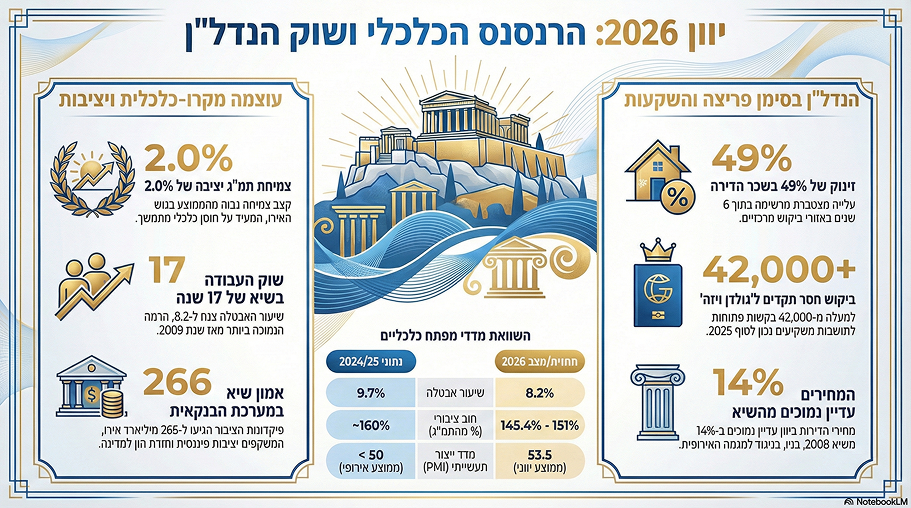
In 2026, Greece presents a complex economic picture that combines impressive growth in macroeconomic indicators with ongoing structural and political challenges. The Greek economy is growing at a rate of 2.0% per year—higher than the eurozone average—while reducing public debt
The real estate market has seen a steady rise in prices, with rents in some areas jumping 49% over the past six years, while foreign direct investment continues to flow in thanks to the "Golden Visa" program. However, there are social disparities, a high concentration of exports, and political instability.
General economic situation
GDP Growth and Macroeconomic Stability
Greece's GDP grew by 2.0% in 2025, with the International Monetary Fund and the European Commission projecting similar growth for 2026.
This growth is driven by an increase in employment to a record high of 4.406 million employed persons in November 2025 (+2.8% from the previous year). The unemployment rate fell to 8.2%—the lowest in about 17 years (since 2009)—compared to 9.7% in November 2024. Nominal disposable income rose by about 0.7% in the first quarter of 2025, primarily from employee wages. The Consumer Price Index (CPI) and the HICP stood at approximately 3.1% in 2025, with a slowdown expected but pressures from wages, rent, and tourism. This figure is higher than pre-pandemic levels but lower than previous peaks.
The Greek economy grew at a rate of approximately 2.0% in 2025, higher than the eurozone average (approximately 0.9%–1.3%), with public debt continuing to decline to approximately 145.4%–151% of GDP by the end of 2025.
The improvement is due, in part, to an initial budget surplus of over 10 billion euros (approximately 74 billion euros in cumulative revenue), which is higher than the surplus projected for 2024, primarily through increased enforcement against tax evasion and a shift to digital payments.
The labor market showed a significant improvement, with unemployment at 7.5% in December 2025 (ELSTAT seasonally adjusted)—the lowest level in about 17 years, down from 9.4% in December 2024 and a peak of 27.9% in 2013.
Forecasts for 2026: approximately 8.4%–8.6% (IMF and the Greek Ministry of Finance).
Gross income continues to rise, but so does consumption, according to data from the Hellenic Statistical Authority. In the first six months of 2025, nominal disposable income for Greek households rose by approximately 0.7%–2.0% compared to the previous year, while wages (employee compensation) increased by 6.2%–8.1% in the second quarter of 2025 (according to the Bank of Greece and ELSTAT).
Overall, the Greek economy is undergoing an impressive transformation, reflecting a long-term recovery following a decade of economic crises. Consistent growth above the eurozone average underscores Greece’s successful recovery from the deep economic crisis. However, the high level of public debt still weighs on future growth potential and limits the government’s ability to invest in infrastructure and essential services.
Table of Key Economic Indicators
The Labor Market and Social Inequality
Structural Changes in Employment
The labor force participation rate has reached a historic high, with 200,000 job openings remaining unfilled due to skill gaps between labor market demands and job seekers' qualifications.
A key problem in Greece is a management culture that perpetuates low wages, coupled with high social security costs for employers. The government’s welfare policy, which includes extensive benefits, reduces the incentive to take minimum-wage jobs.
The Greek economy presents an interesting situation: on the one hand, record-high employment and a large number of job openings; on the other hand, unemployment that remains at significant levels. This situation points to a deep structural gap between workers’ skills and the needs of the modern economy—a problem that requires comprehensive reform of the education and vocational training systems.
Deposits on the rise
Confidence in the Greek banking sector is on the rise—despite interest rates remaining low, public and government deposits in Greece have reached 266 billion euros.
The impressive increase in the volume of bank deposits in Greece marks a historic turning point in the relationship of trust between the Greek public and the financial system. This phenomenon is particularly striking given that it is occurring in an environment where interest rates are still considered relatively low, suggesting that factors other than mere financial returns are at play.
This positive trend reflects a fundamental transformation in the Greek banking system, which underwent comprehensive reforms in the wake of the economic crisis. Greek banks have invested considerable effort in restoring their balance sheets and reducing the volume of non-performing loans. As a result, Greece’s four largest banks now exhibit capital adequacy ratios and financial stability at the highest levels in their history, in line with strict European standards.
The reasons for the increase in deposits are varied and reflect positive trends on several fronts: First, the overall improvement in the economic situation, with rising disposable income and wages, is enabling more Greek households to save a portion of their income. After years of reducing personal debt, many now prefer to build a financial safety net before returning to their previous spending habits.
Second, the recovery in the labor market has led to a significant decline in the informal economy, which was widespread at the height of the crisis. More transactions are now taking place through formal channels, with wages paid directly into bank accounts, thereby increasing the amount of money in the banking system.
A third factor is the repatriation of Greek capital that had been moved abroad during the crisis. With the stabilization of the financial system and the lifting of capital controls, many Greek investors are bringing some of their assets back to their homeland, which is contributing to an increase in deposits.
Fourth, targeted government policies have encouraged the transition to a digital economy and a reduction in the use of cash. Incentives for electronic payments, including significant tax benefits for credit card users, have led to more funds being deposited in the banking system.
The economic significance of this trend is far greater than the raw figures suggest. The increase in deposits provides Greek banks with a solid foundation for expanding their lending activities, which in turn supports investment in the economy and economic growth. Banks are already increasing the volume of mortgages and business loans.
The industry is growing
Greece’s industrial sector showed consistent growth in production and orders in the first quarter of 2025 (PMI average of 53.5), with peaks such as 55.0 in March—according to S&P Global. Compared to the rest of the Eurozone (average below 50), Greek industrial performance remained the strongest in the region.
Industrial growth stems, in part, from strategic investments in innovation and technology, which enable Greek manufacturers to carve out unique niches in global markets. A growing number of Greek industrial companies are successfully specializing in specific fields—from advanced processing of Mediterranean food products, through the pharmaceutical and cosmetics industries based on unique local raw materials, to the production of precision components for renewable energy systems. These specializations enable them to capture significant international market shares, despite fierce competition.
The Greek industrial sector also benefits from the country’s strategic geographical location as a bridge between Europe, Asia, and Africa. The deep-water ports in Athens and Thessaloniki, which have undergone significant modernization in recent years, provide Greek industry with efficient access to global markets and enable seamless integration into global supply chains. This advantage becomes particularly significant in an era of disruptions in global supply chains, as international companies seek to diversify their production bases and bring them closer to European target markets.
The current Greek government has adopted an ambitious "reindustrialization" strategy, which aims to increase industry's share of GDP to 15% by 2030. As part of this effort, attractive tax incentives, bureaucratic streamlining, and support for industry-tailored vocational training are being offered. These efforts, combined with European Recovery Fund money directed toward the digitization and modernization of industry, create a supportive ecosystem that accelerates the sector’s development.
The resurgence in the industrial sector is an encouraging sign for the Greek economy, which had been overly reliant on tourism and services. This diversification of growth sources strengthens Greece’s economic resilience to external shocks, as demonstrated during the COVID-19 crisis. It should be noted that industrial growth is not evenly distributed across all regions, which may create regional disparities.
In terms of workforce, the Greek industrial sector is undergoing an interesting transformation—younger, better-educated workers, many of whom have advanced technological training, are joining the industry and bringing with them innovative approaches and digital skills. This phenomenon, referred to in the local media as the “Greek industrial renaissance,” is boosting the sector’s productivity and competitiveness and attracting additional investment from venture capital funds and strategic investors.
Particularly notable is the growth in knowledge- and technology-intensive industries—ranging from electronics to biotechnology and advanced materials. Greek companies in these sectors are posting double-digit growth rates and penetrating competitive international markets. Their success demonstrates that Greece is not merely a seasonal tourist destination, but also a hub for industrial innovation of growing regional importance.

Social Perceptions and Income Gaps
Despite the improvement in income, 70% of Greeks believe their children will be poorer than they are—a rate higher than the European average of 57%. This gap is also reflected in public perceptions: on the International Monetary Fund’s index, Greece ranks third in the world in terms of the perceived gap between rich and poor, behind Turkey and the United Kingdom.
The widespread pessimism among Greeks regarding their children’s future reflects a deep social trauma stemming from the prolonged economic crisis. The gap between the improving economic reality and public perception underscores the need for a more equitable distribution of the fruits of growth and for the restoration of public trust in state institutions.
Real Estate in Greece
Real Estate real estate market in Greece is undergoing a significant transformation in 2026 and is becoming an attractive destination for local and international investors. Despite a turbulent economic past, Greece has positioned itself as a promising real estate investment hub, characterized by strong growth, attractive prices, and unique opportunities.
Despite nearly seven years of continuous growth, housing prices in Greece remain relatively low compared to most European countries—a factor that attracts many foreign investors. According to the president of the European Real Estate Agents Association, the low prices serve as a magnet for foreigners seeking returns and the opportunity to live in a popular tourist destination.
The residential real estate market in Greece continues to grow, with apartment prices rising by 6.8% in the first quarter of 2025 (Bank of Greece)—a slowdown from 8.9% in 2024 but still relatively strong. In the first half of 2025, property transfers resulting from property purchases in Greece surged by approximately 15%–20% (preliminary estimates), generating approximately €350 million in state revenue.

Demand for properties in cities such as Athens, Thessaloniki, Crete, and Lefkada exceeds supply, leading to significant price increases. In 2024–2025, apartment prices in major cities rose by between 6.6% and 9.6% annually (Q3 2025), and in Athens by approximately 6.6% during the same period (following an 8.5% increase in 2024). This marks the tenth consecutive year of increases, but apartment prices in Greece are still about 14% below their 2008 peak, in contrast to many European countries where prices are 37% higher on average. The mortgage market is picking up, and more Greeks are obtaining mortgages from banks—a trend expected to expand to foreign investors as well.
The number of new construction starts is on the rise, particularly in new residential and tourism projects, but it still does not keep pace with demand. The cumulative increase in rent has reached 49% over six years in certain areas, while real income has grown only marginally.
The increase in new construction starts reflects developers’ and contractors’ optimism about the market’s future and promises an expansion of supply that will meet growing demand. These new projects are characterized by higher standards of green building, energy efficiency, and modern design, raising the bar for quality across the Greek real estate market. As a result, Greece is becoming not only an economically viable investment destination but also a preferred place to live with a high quality of life, combining the benefits of a Mediterranean climate, a rich culture, and improving infrastructure.
Looking ahead, massive investments in transportation and energy infrastructure, coupled with the shift toward a more digital economy, are expected to support continued growth in the Greek real estate market and cement Greece’s position as one of the most promising opportunities in the European real estate market in the coming years.

Foreign Investment
Foreign direct investment (FDI) continues to flow into Greece, with real estate accounting for about half of the total amount invested in the country.
The "Golden Visa" program—which offers residency to investors who invest at least €400,000 or €800,000 in popular regions—has seen an increase in recent years, despite raises in the minimum investment threshold. As of October 2025, the number of pending applications for a Golden Visa in Greece stood at approximately 42,390, with about 7,200 new applications in 2025 (an average of 600 per month).
A notable trend is the growth of the serviced apartment market in Athens, which is considered an undersaturated market with a growth potential of 15% per year, primarily due to demand from young professionals, businesspeople, international students, and tourists.
Greece’s “Golden Visa” program serves as a strategic and smart growth engine that has successfully positioned Greece as an attractive investment destination on the global real estate map. The continued rise in the number of applications, even after the minimum investment threshold was raised, indicates growing confidence among international investors in the long-term potential of the Greek market. These investors not only inject vital capital into the economy but also bring with them knowledge, business connections, and international standards that elevate the entire sector. The multiplier effect of these investments is evident in related fields—from interior design, architecture, and construction to financial services and luxury tourism.
Looking ahead to 2026 and beyond, the Greek real estate market shows promising signs of continued growth and development. Key factors to watch include potential adjustments to the “Golden Visa” program, continued development of serviced apartments in urban centers, and the impact of global economic changes on foreign direct investment.
Political and Geo-Economic Challenges
The government, led by the "New Democracy" party, is suffering from a sharp decline in public confidence, while the main opposition party has also lost support. This situation is leading to a rise in the influence of extremist political groups.
Climate Impacts and the Green Economy
The average temperature in 2024 was the highest in 34 years, with frequent extreme events such as massive wildfires and floods. These trends threaten the tourism and agriculture sectors, which are economic pillars. Despite investments in the technology sector—including AI and offshore solar projects—Greece is still in the early stages of transitioning to a sustainable economy.
Summary and Recommendations
The Greek economy in 2026 exhibits macroeconomic strengths alongside structural weaknesses. While reforms aimed at reducing debt and increasing revenue are bearing fruit, the main challenges remain the concentration of exports, income disparities, and a deepening housing crisis. At the same time, political turmoil threatens the stability needed to continue reforms. For long-term sustainability, a strategic plan is required to address skills gaps, reduce export concentration, and promote a comprehensive housing policy. Furthermore, the implementation of proactive climate policies could transform environmental threats into an opportunity to reposition the Greek economy.